

We love rolling up our sleeves and digging deep into the data. SaaS Browser has a massive database of SaaS, so this insight should be telling.
Whether you’re an investor looking to buy a SaaS, a would be partner, or another SaaS tool to help other SaaS grow, knowing a SaaS company’s revenue level can drastically affect your decision-making.
Unfortunately, most countries do not require private companies to disclose financial statements publicly. Even in large markets like the United States, where transparency laws are strong in many areas, private companies are under no obligation to publish their revenue numbers unless they’ve gone public or been acquired.
This creates a significant blind spot, particularly in a sector as large and rapidly evolving as the SaaS industry. If you’re an investor, you might be interested in targeting only companies already generating $10M+ in ARR.
If you run a dev agency, your sweet spot could be early-stage SaaS startups that haven’t built out a whole in-house engineering team yet. If you offer fractional CTO or CFO services, you may be targeting bootstrapped or pre-revenue companies that are still finding their product-market fit.
Either way, understanding a company’s revenue, even roughly, is critical to qualifying leads, better prospecting, segmenting the market, or simply understanding where your offering fits.
So, how do we solve this when the data isn’t public?
Over the past several months, we’ve worked on this very problem at SaaS Browser, the world’s largest SaaS search engine, doing our best to track every single SaaS company in existence. We compiled data from hundreds of SaaS companies across multiple regions. We used a combination of confirmed revenue disclosures (from media coverage, founder blog posts, interviews, and social posts on platforms like X) to map those numbers to a surprisingly accurate predictor: Domain Rank.
What Is Domain Rank and Why Does It Matter?
Domain Rank, in today’s usage, is a domain authority metric that reflects how powerful, authoritative, and well-linked a website is on the internet.
Although the term originally came from Google’s now-retired algorithm, it has evolved into an umbrella term used to describe a range of similar scores offered by third-party SEO platforms.
Different providers have different names for it:
- Ahrefs calls it Domain Rating (DR)
- Moz uses Domain Authority (DA)
- SEMrush offers an Authority Score
- Serpstat offers a Domain Rank
All of these are measured on a scale from 0 to 100. A higher score generally means the site has a strong backlink profile, gets frequent mentions from other trusted sites, and holds significant weight in search engine visibility.
In the SaaS world, this authority typically increases with company scale. Larger SaaS businesses tend to publish more, partner more, and attract more attention, all of which contribute to a stronger domain score.
This makes Domain Rank a very reliable signal of company scale, mainly when analyzed across large datasets.
Revenue by Domain Rank: What the Data Tells Us
After compiling hundreds of data points from both disclosed revenues and correlated Domain Rank scores, we grouped SaaS companies into revenue bands and measured the 25th and 75th percentiles for each group.
Here’s what we found:
| Revenue (USD) | 25th Percentile (Domain Rank) | 75th Percentile (Domain Rank) |
| $100M+ | 40 | 54 |
| $10M – $100M | 29 | 41 |
| $1M – $10M | 22 | 33 |
| <$1M | 9 | 27 |
For the more visually included (who doesn't love a chart over a table?):
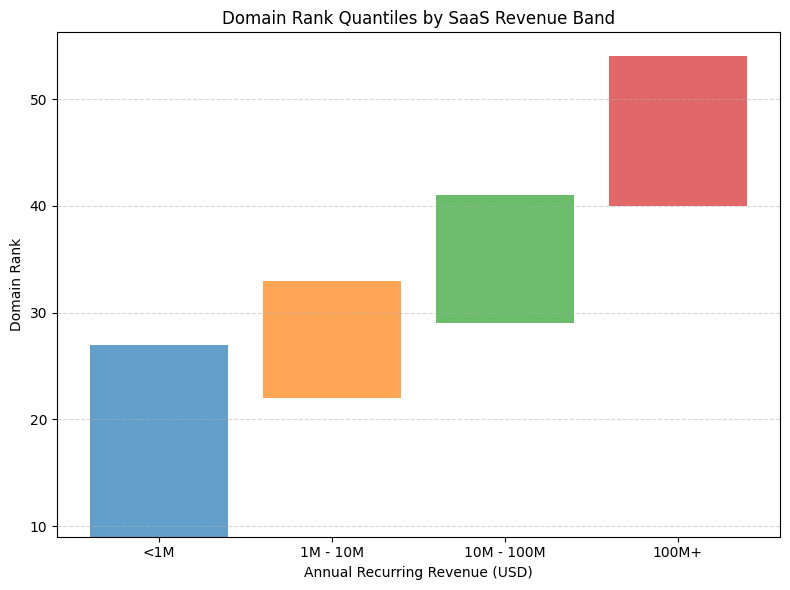
This means that 50% of SaaS companies earning between $10M and $100M in revenue have a Domain Rank between 29 and 41. Similarly, those making under $1M are primarily in the 9 to 27 range.
These are referred to as the 25th percentile (p25) and 75th percentile (p75) values, which define the interquartile range, a standard statistical method for illustrating the middle 50% of a data distribution.
We can clearly see a very obvious relationship. If a SaaS has a Domain Rank of less than 30, there's a very high probability it is in the sub-$1m category.
In layperson’s terms, if a company’s Domain Rank falls within these ranges, there’s a high probability that its revenue falls within the corresponding band.
How to Predict Revenue Using Domain Rank
Predicting SaaS revenue using Domain Rank isn’t an exact science, but it’s surprisingly accurate in broad strokes. Here’s how to do it:
- Find the company’s Domain – Go to their homepage and note the root domain (e.g., example.com).
- Check their Domain Rank – Use tools like Ahrefs, Moz, SEMrush, and SerpStat to find their domain authority score.
- Match it to the range – Use the chart above to estimate which revenue bracket the company likely falls into.
For example, if a SaaS company has a Domain Rating of 64 in Ahrefs, it’s very likely in the $100M+ range or just on the edge. If another company scores 18, they’re likely below $1M in ARR.
This method won’t tell you exactly if a company is making $6.2M or $8.9M, but it will put them in the right ballpark. And for most use cases, whether you’re qualifying leads, targeting outbound, or evaluating acquisition prospects, that’s often more than enough.
How Else Can You Estimate SaaS Revenue?
While Domain Rank is arguably one of the easiest and quantifiable proxies we’ve found, it’s not the only signal you should look at. If you want to dig a little deeper, here are some other ways to cross-check or strengthen your revenue estimates:
- Hiring signals – Companies that are actively hiring, especially for senior roles, likely have budget and traction.
- Funding history – If they’ve raised large VC rounds, there’s usually a press release or Crunchbase record to give you context.
- Press and media coverage – News features often hint at growth rates, milestones, and major customer wins.
- Job listings – Listings that mention “1000+ customers” or “millions in ARR” can be revealing.
- Founder posts – Many SaaS founders now share revenue milestones transparently on their blogs or social platforms like X, not as a brag but as part of an honest startup journey.
These signals can be combined with Domain Rank to build a stronger confidence interval around your estimate.
Conclusion And How To Use It
Domain Rank is far from perfect, but when aggregated and interpreted correctly, it becomes one of the most powerful tools available for estimating revenue for any given SaaS business.
It’s objective, widely available, and highly correlated with company scale. For many teams, investors, marketers, consultants, and recruiters, being able to segment the SaaS world by revenue is a huge operational advantage.
At SaaS Browser, we’ve built the world’s most exhaustive database of SaaS companies, doing our best to track and catalog every single one in existence across all categories, geographies, and stages. As part of that mission, identifying scalable, practical metrics like Domain Rank helps us and our users bring more clarity and insight to a traditionally opaque market.
If you’re working with SaaS companies in any capacity, Domain Rank is a metric you should be paying attention to. It might not tell you the exact number, but it can tell you enough to make smarter, faster decisions, and our data proves that.
Give SaaS Browser a try for free today!