
Benjamin Thornton, Head of Growth of Keyword.com, has been helping SEO professionals track their visibility since 2012. But like many long-running SaaS companies, Keyword.com hit a plateau that lasted for years. Through strategic product evolution and hard-won lessons about pricing, Benjamin managed to break through that ceiling, achieving a 30 percent increase in active customers over the past 12 months. Today, with 2272 paid customers, Keyword.com is positioned at the intersection of traditional and AI search, solving problems that didn't even exist when the company first launched.
What Keyword.com Does
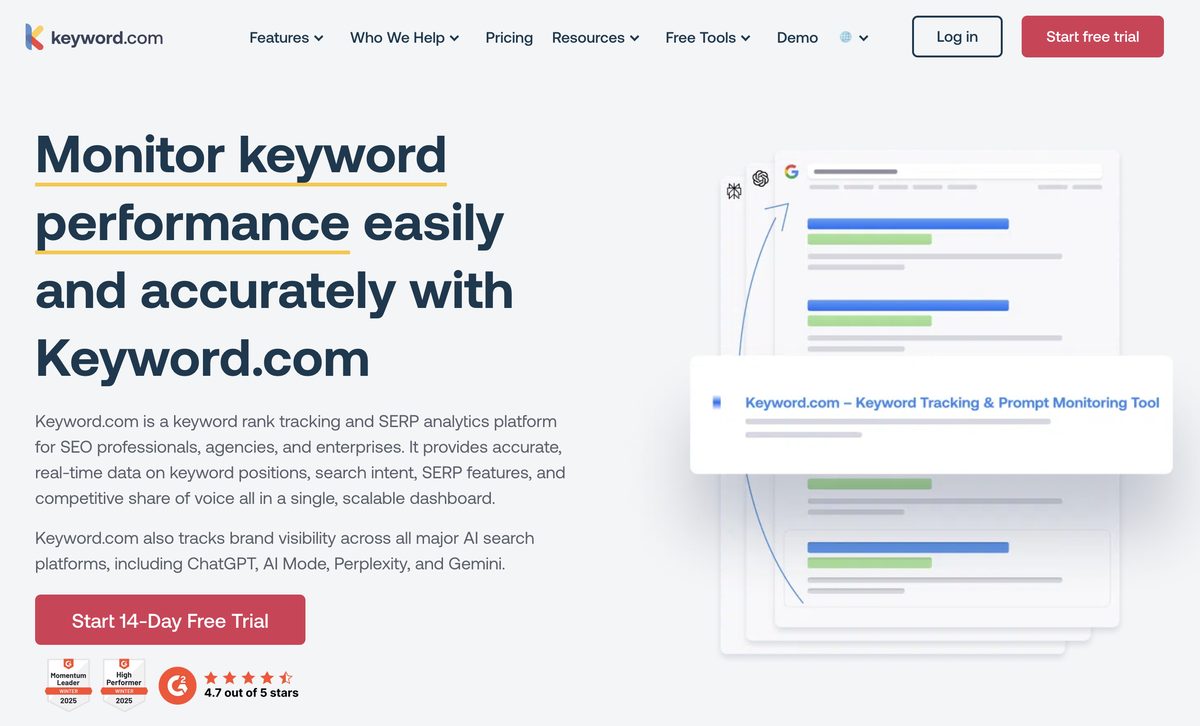
Keyword.com tracks website visibility across both Google and AI search engines like ChatGPT, Perplexity, and Gemini, giving users a complete view of their search presence. The platform is built specifically for SEO agencies and in-house SEO teams that need clear, reliable visibility tracking across both traditional and AI search engines. For agencies, Keyword.com provides scalable rank tracking and reporting tools that help monitor performance across multiple clients worldwide, making it easier to demonstrate ROI and compare visibility across different search platforms. For in-house teams, the platform delivers precise insights into website and brand visibility in one unified dashboard, empowering them to understand how their content appears online and align strategy with real visibility data. The target customer base includes heads of agencies as well as heads of SEO and marketing professionals who are focused on boosting their website visibility.
The Evolution From Google Tracking to AI Visibility
The story of Keyword.com didn't start with AI search engines because those didn't exist yet. Benjamin explains that the company has been helping SEO professionals since 2012, and the expansion into AI visibility tracking was a natural evolution rather than a pivot.
"Since 2012, Keyword.com has helped SEO professionals track their visibility on Google, and as AI search engines like ChatGPT, Perplexity, and Gemini began transforming how people search and discover information, expanding into AI Visibility Tracking represented a natural step in the evolution of our product."
The philosophy behind this evolution stems from a belief that the market was creating a false choice for users. Benjamin and his team observed that many tools focused solely on either Google rankings or AI search visibility, but not both.
"Our philosophy is that true online visibility demands a comprehensive, holistic view that gives a complete view across Google and AI search presence, not either or."
This wasn't just about adding features to stay relevant. The aim remained consistent with the original mission from over a decade ago. "Our aim has always been the same – to empower marketers and agencies with the most relevant and reliable visibility tracking solution across traditional and AI search ecosystems."
The direction continues to evolve based on this unified approach. "The direction of our product continues to evolve toward providing that unified approach to visibility."
Solving Problems Others Weren't
The expansion into AI visibility tracking addressed several gaps in the market that competitors weren't solving effectively. The first and most obvious was visibility into AI search engines themselves. As Benjamin notes, the rise of these new platforms created measurement problems that traditional tools couldn't address.
"The rise of AI search engines has made visibility harder to measure. Keyword.com addresses this by helping SEO professionals see when and where their brand appears in AI generated answers."
Beyond the technology itself, Keyword.com tackled practical business problems that agencies face daily. Transparency and client trust emerged as a major pain point.
"Agencies spend a lot of time piecing together data from different tools just to show clients results. Keyword.com simplifies this by offering transparent, client ready reporting that clearly demonstrates visibility growth and ROI, which helps agencies build trust and retain clients."
The platform also addressed specific technical challenges like local search tracking and scalability. For local search, Keyword.com offers ZIP code level accuracy, allowing businesses to track rankings with precision in specific geographic markets. For scalability, the platform provides unlimited domain tracking, giving agencies, enterprises, and in-house teams the freedom to track as many domains as needed without worrying about usage limits.
Perhaps most importantly for agency relationships, Keyword.com introduced a feature called Spyglass that provides third-party verification.
"With Spyglass third party verification, every ranking is backed by verifiable proof (see a screenshot of the SERPs)." This feature directly addresses the trust issue that can arise when clients question the accuracy of reporting.
The Challenge of Pricing Strategy
After years of operating in a relatively stable market, Keyword.com faced a period of stagnation that forced Benjamin to confront uncomfortable truths about how the business was structured. The biggest lesson came from an area that many SaaS founders treat as secondary: pricing.
"For years, we operated in a market with little competition, which meant we didn't have to think too deeply about how our pricing compared to others or aligned with customer expectations. In hindsight, we neglected the crucial task of thinking strategically about how pricing fits into our long term vision as a company and the expectations of users in this industry."
The impact of this oversight was significant and lasting.
"Looking back, our old pricing model was likely one of the main reasons behind our period of slow growth."
This realization came only after years of flat growth, making it a particularly expensive lesson.
Last year, the team introduced a new pricing structure that provided more flexibility to users, and the results were immediate. The 30 percent increase in active customers that Benjamin is proud of today came directly after this pricing overhaul. But even with this success, the work isn't finished. "Last year, we introduced a new pricing structure that helped us to grow again, by providing more flexibility to our users, but even now, we're seeing where it can be improved (hint hint)."
Benjamin's perspective on pricing has fundamentally shifted through this experience.
"Pricing is often treated as an afterthought for many marketers, but we've learned that even small changes in how you price your core product and add ons can completely reshape your growth and revenue trajectory."
He also warns against the common practice of regular price increases as a growth strategy.
"Many companies are quick to raise prices every so often as an industry standard (something we also fell prey to) but while this approach may raise revenue in the short run (but with oftentimes a rise in churn later on canceling out this increase), a general price increase shouldn't be the first line of action when it comes to pricing strategy."
Staying Connected to Customer Needs
While pricing was the structural change that unlocked growth, Benjamin attributes the company's ability to build the right features to a more fundamental practice: constant customer communication. When asked about one approach that worked, his answer was straightforward and customer-focused.
"Talking to customers on a constant basis to make sure that we are always aware of how they're feeling about our product, what are their needs, what are their main blockers, and making sure that whatever feature we develop always responds to something that responds to a real need or solves a real problem, not just adding a feature for the sake of adding a feature."
This approach kept Keyword.com focused on solving actual problems rather than building features that looked good on paper but didn't move the needle for users. It's what allowed them to identify the specific pain points around AI visibility, agency reporting, and local search that became their competitive differentiators.
The Current Challenge and Future Direction
Despite the recent growth, Benjamin is clear-eyed about the challenge ahead. The current structure of Keyword.com treats Google visibility and AI visibility as two separate products, and unifying them is the company's primary focus.
"Our biggest challenge right now is building the next evolution of our product: combining Google visibility and AI Visibility into a single, seamless dashboard. Today, these exist as two separate products, and unifying them into one coherent experience is our key focus moving forward."
This challenge is made more urgent by the changing competitive landscape. The barriers to entry in this market have dropped significantly with the advent of large language models.
"LLMs have made it easier than ever for new competitors to enter the market, resulting in a ton of AI Visibility tracking tools with very little differentiation."
Benjamin sees the solution in leveraging Keyword.com's history and expertise to create something competitors cannot easily replicate.
"Our goal is to leverage over a decade of experience in search visibility to create something truly unique: a platform that combines AI Visibility with Google SERP tracking into one cohesive, insightful view of how websites are discovered online."
Looking Ahead
For SEO agencies and in-house teams struggling to understand their visibility in an increasingly fragmented search landscape, Keyword.com offers a solution built on more than a decade of experience in search visibility tracking. If your team is piecing together data from multiple tools or struggling to demonstrate ROI to clients, Benjamin and his team have built a platform specifically to solve those problems. You can learn more at keyword.com, and Benjamin shares regular insights about AI search and SEO on the Keyword.com YouTube channel. He also posts frequently on LinkedIn where he welcomes connections from others in the SEO and marketing space.